

We are all familiar with the expression: “We are in the same boat, …… do not rock it”. My curious mind is on a journey to compare various economic growth forecasts in an attempt to establish their consistency. I am also interested, whether countries around the world are in fact in the same boat. It is not an enigma that the current crisis has created a unique opportunity for a major reshuffle among the world’s economic superpowers.
Whilst it is crystal clear that the US and China are in separate proverbial boats, the position of the UK is not yet clear. Call it a coincidence or Sod’s Law, but the timing for Brexit negotiations cannot be worse for both sides. The question is which side has more at stake? Here are some projections for GDP from IMF to get our discussion on the way:
GDP Forecasts
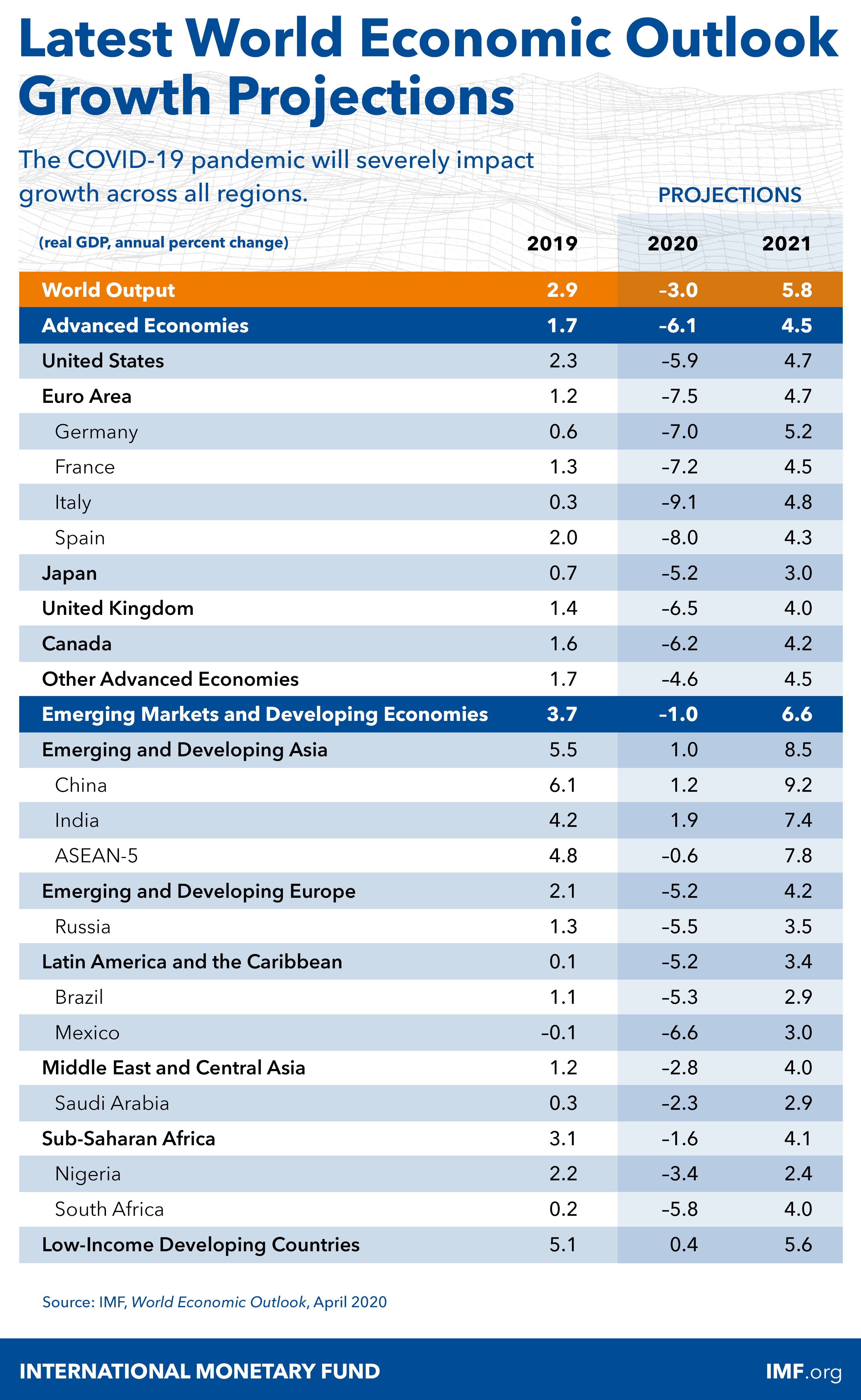
I’ve collected some data from the media and panels. The outlook is somewhat different from that of the IMF’s projections:
| GDP forecasts: | US (by Reuters poll) | UK (by OBR) | Eurozone-19 (by EC) |
| Q1 2020 | – 4.8% | – 2% | – 3.8% |
| Q2 2020 | – 30% | – 35% | n/a |
| Q3 2020 | + 12% | n/a | n/a |
| Q4 2020 | + 9% | n/a | n/a |
| 2020 total: | – 13.8% | – 12.8% | – 7.7% |
Note: assumed real-GDP
Unemployment Forecasts
| Unemployment forecasts: | US (by Reuters poll) | UK (by Statista) | EU (by Eurostat & EC) |
| Q1 2020 | 14.7% (April 2020) | 3.8% | 7.5% (2019) |
| Q2 2020 | 13.7% | 10% | n/a |
| Q3 2020 | 11% | 8.5% | n/a |
| Q4 2020 | 8.5% | 7% | 9.6% |
Examples of some UK Counter-Measures
The Bank of England (BoE), through its Quantitative Easing (QE) programme, has stimulated the UK economy since the start of the crisis. In March, it “created” £210bn to buy bonds and lower lending costs. However, there are consequences of such methods of money “creation”. In May 2020, BoE “stopped short of launching more bond-buying via QE and left interest rates on hold”. Despite the containment, i.e. creating £100 bn more money for the total of £310 bn, this round is the largest since BoE started practicing QE in November 2009.
Treasury analysis revealed by The Telegraph in mid-May showed the government’s budget deficit would likely rise to £300 bn in 2020 – a sixfold increase from projected before the pandemic.
Recently the UK’s Chancellor proposed to pay 80 per cent of the wages, up to £2,500, to workers that would otherwise be laid off.
Another measure is to issue £5.5bn of grants, distributed via a number of authorised UK banks, for small and medium-sized businesses.
To date the UK banks have approved circa 1.2 million mortgage holidays to ease the financial strain on households.
A View on the Effectiveness of Counter-Measures
GDP and Budget Deficit
According to April’s Reuters poll the US economy is set for a 3.8% rebound in 2021, which is 0.9% point lower than the IMF projection of 4.7%.
The OBR’s scenario for the UK GDP projects a fall of 12.8 per cent in 2020, followed by a rise by 17.9 per cent in 2021. The projected result of 5.1% growth is 1.1% point higher than the IMF’s 4% forecast for the UK’s GDP in 2021.
Advantage of QE
The QE practice is a fairly modern instrument in the Central Banks’ toolkit (e.g. started by BoE in November 2009). The upside of QE is keeping the Financial Industry afloat, every government, and the UK is not an exception, is instinctively petrified of the effects of the 2008 Financial Crisis.
Perceived disadvantages of QE
The known perceived disadvantages of QE or ‘asset buyback’ include:
- Introduction of so much more money into the economy, even if it is electronic money (not coins and banknotes), may give rise to inflation;
- BoE buys out assets mainly from financial companies, e.g. pension funds, etc., which could be asynchronous in terms of benefiting the real economy;
- It is assumed that the money raised by such financial companies will get reinvested into the real economy;
- But the rock bottom interest rate, looming insolvency of so-called ‘zombie’ companies and rising unemployment may render this money either sitting on the balance sheet or getting invested outside of the UK, e.g. the USA, China or India. Sounds like a plausible scenario?
Unrealised potential of QE
- There is a rising sentiment that QE money should instead be invested directly into the so-called ‘public’ economy;
- It means that the government should cut out an intermediary financial company by directly investing into infrastructure, services and/or sectors.
- Theoretically, the money should find its way directly to people in the form of wages, jobs will get created, productivity will rise and directly boost the systemically important sectors of the economy.
Bridging the Budget deficit
Arguably, one of the most important questions today is, whether there are already effects of permanent or irreversible scarring on the economy? The effect being: in a smaller / contracted economy the government collects less tax revenue.
Then, what are the revenue sources to bridge this £300 bn budget deficit? Especially, when the Cabinet and the PM publicly announced that government would not pursue a round of austerity in the future to cut the deficit.
Another observation is that in times of deep crisis part of the functioning economy might turn ‘black’, i.e. no tax revenue may get collected for goods and services traded.
Finally, barter is another way of trading goods and services that may fall under the Office for Budget Responsibility (OBR) and Office for National Statistics (ONS) radars.
Pitfall of Furlough and SME Grant schemes
In early May 2020, there “was talk among some economists that the government’s furlough scheme was hiding how many businesses had really gone bust over the past two months”.
Essentially, this means that the money is a so-called ‘sunk cost’ with regard to keeping the businesses solvent and saving jobs. Also, the public will never see the loans repaid if the businesses are bust.
The upside is that an individual (and, presumably, a household) benefited from the money for personal consumption and reintroduced it into the real economy.
It is not an enigma that the word ‘grant’ in the SME Grant Scheme is a euphemism for an interest-bearing business loan. A number of banks, for example, Metro Bank and Nationwide, had withdrawn from acting as government agents for the administration of such grants to SMEs.
Even without the interest, a majority of companies may struggle to repay the principal amounts. Is this another ‘sunk cost’ investment that the government wrapped up into the national debt for repayment by the current and future generations of taxpayers?
Unemployment
Forecast for 2020-21
Office for Budget Responsibility (OBR) and Office for National Statistics (ONS) forecast for the unemployment in 2020 is a flat 4.1% across Q1-Q4 and a flat 4% across Q1-Q4 2021. It does not feel as if the OBR and ONS tandem have reasonable modelling tools at their disposal, if they only report on the historical periods.
For comparison, Statista offers an upside-down V-curve starting from 3.8% in Q1, passing though 10% in Q2 and ending at 7% in Q4 2020. Its projection is that the unemployment rate will ease to 5.5% by Q4 2021.
Jobs retention
We already discussed that QE may not be the catalyst of job retention and/or creation, if the money released by the financial companies from the sale of bonds is not reinvested into certain sectors of the economy.
There are also persistent rumours that a large number of City institutions may start laying off staff due to diminishing margins and profitability.
In the current contract market, the self-employed, who are already suffering from the debacle of IR35 in the private sector, sliding demand, lower contract rates and a diminishing number of permanent roles will find themselves in dire financial situation.
If the main intended objectives of the government’s furlough scheme fails, mass lay offs will follow when the scheme ends.
The downside of introducing mortgage holidays without employing the usual consumer credit risk models, may merely delay a succession of mortgage defaults at the end of Q2 2020. All of the above forecasted figures strongly point to such an outcome.
Summary: intended and unintended consequences
Unintended consequences
Statistical data, the way it was collected and analysed in the past, is not entirely fit for the current crisis’ scenario building and economic modelling.
The forecasts by IMF and independent panels are overly optimistic. They assume the upturn and return to positive GDP and unemployment rates by mid-2021. Previous recessions, all of smaller magnitude than the current one, had an average recovery rate of 3-4 years.
What makes specialists believe that the world and/or individual economies have the potential and resilience to bounce back in 12 months? Especially, if we take pre-existing conditions and asynchronous pattern of recovery into the equation.
Balances and measures that help to recover an economy in recession do not work, when entire sectors of the economy are shut down in a command way; only to be open under conditions in which they are not designed to function.
The current focus is on reversing the negative GDP trend. It is unlikely that the recovery will take a fast and effective V-shaped trend. Due to ‘symmetric shock’ across the countries and sectors of the economy, but an emerging trend of ‘asymmetric recovery’, the majority of the world’s economies are facing a drag of U-shaped improvement. Therefore, an attempt to recover them all at once is a scenario for disaster.
The government needs to consider redirecting the ‘created’ money in QE, cutting out the ‘middle-man’ financial companies, into specific sectors of the economy, which are likely to recover with increased productivity and production output.
Another measure, is to introduce protectionist policies for the local workforce, such as grants (not loans) for re-training workers, whose sectors of the economy have been made entirely extinct.
In addition, there should be additional policies for employers, mandating that they advertise all jobs locally and nationally, prior to awarding them to foreign nationals and corporates.
Finally, create incentives for employers to follow these policies in the form of special tax regime, e.g. lower VAT, larger tax relief for R&D in certain fields and for re-training employees. The policies could be revised, if necessary, when the economy turns firmly into the green.
Intended consequences
The European Economic Forecast, Spring 2020, Institutional Paper 125, May 2020 by the European Commission talks about Brexit as “reaching the end of the transition period foreseen in the Withdrawal Agreement between the EU and the UK will dampen economic growth, even if a free trade agreement between the EU and the UK is concluded. This will affect particularly the UK, but also the EU, albeit to a lesser extent.”
I’ve already commented that the return to performing economies by mid-2021 is an over-optimistic scenario fo both the UK and the EU. Both parties need to forget the proverbial ‘vendetta’ (e.g. punishment for staying or leaving) and co-operate to minimise the effects of the current crisis.
It is my forecast that the EU may find that the effects of asymmetric recovery hit a number of countries of the block harder than its economically diverse and stronger members. Even if the economy of the Eurozone and the EU holds to the projected recovery trajectory; some political and social discord may threaten the core values of the Union.
Wealth and finances
I read opinions and analysis that attempt to compare the current crisis to the 2007-08 Financial Crisis. However, I cannot help but notice similar areas of weakness in the academic and professional commentary, for example:
- Pre-existing underlying conditions do not fit as convenient variables for the existing scenario models;
- The historical data is not fit for the purpose of running economic and financial recovery models;
- Public finances are in dire state as being unable to off-set even slight deviations from the main economic indicators such as real GDP, Unemployment, Trade Deficit and Inflation;
- Over dependency on the use of mechanisms such as Quantitative Easing (QE), when there is already evidence that majority of governments display poor judgement regarding the spend of the newly created money, i.e. where to invest and which players to bail out;
- Chronic delayed effect with decision-making at the highest levels of power, caused by over-reliance on orthodox advisers and specialists.
For the general public, the current crisis has far more devastating effects and consequences than the previous one. These effects are deeply rooted in the existing system of distribution of labour and wealth.
This crisis brings not just a reduction in labour as such, but a destruction of whole segments of free enterprise and ways of earning a living. We are down to a basic style of the labour market. The government, as the largest and most stable employer, shares the monopoly for wealth creation with large corporations, whilst the majority of self-employed, SMEs and ‘zombie-companies’ are getting wiped out.
For example, in the current crisis the system of wealth creation, based on home ownership financed by a mortgage, furnishes people with the worst type of ‘asset’. It is not liquid, it is subject to plunging into negative equity and, in case of no income due to unemployment, it is the most difficult debt to service.
In fact any credit card, personal loans and personal finance debt will not do people any favours in the near future; remember, businesses are also desperate and will take desperate measures to recover the debt. Advice is to restructure any debts as soon as possible into manageable payment plans.
Dropping demand for luxury goods, entertainment and holidays will inevitably finish off certain industries, but will create space and opportunity for the rise of the real economy, which will serve people’s necessities and keep consumerism in check.
Till electric cars can fly …..
I’ve also been looking for signs of improvement in the environment. Observations from conservationists are that the lockdown has reduced the air pollution in industrial and metropolitan areas. However, I am not yet sure what scares me more, the air pollution or death of the UK economy.
The optimism of some leaders that we will all get on our push bikes is a bit overrated. Our NHS cannot even handle an advanced flu pandemic. Imagine if all of us start seeking referrals for knee, ankle and other bicycle-related injuries? Let’s just continue with the technical progress until the electric cars can fly, ok.
Disclosure: Financial Botanik is not supported by referral fees from any party. The article does not cover each and every participant in the market or all of their product / services. The information which is contained in these articles is subject to change at any time. Financial Botanik aims to help readers gain better understanding of the market and its driving events, promote discussion and increase financial awareness.


